


Being a Dad-at-School is One of the Many Benefits of Being a Work-At-Home Dad

Updated: Apr 24
An Earth Day 2026 Reflection
By Scott Beller
Daddying Editor
I've said many times that my rock-star spouse, Elisabeth, is the main reason I'm able to remain an involved Dad. Back in 2021, in a Daddying post celebrating her on her birthday, I wrote:
"She's an even more amazing mom than she is a senior executive. In short, she's great at what she does and everything she does for our family makes what I do not only possible but also better for her support."

Being here every day to help raise our daughters has been a gift. As a work-at-home Dad, it's also been the most important and rewarding job I've ever had. In addition to witnessing all their important developmental moments at home, I've enjoyed volunteering in my daughters' classrooms, from preschool through middle school.
Side note: shout out to Virginia, which just became the first state to sign paid family leave into law, effective beginning December 2028. If only more states would follow.
Over the years, the flexibility of my work as a writer and consultant has dovetailed nicely with being a Dad. And being a Dad eventually led me into the blogging world, first, as a writer for the STEM/STEAM blog Raising Nerd in 2016, which happened to be during the height of my presence in the kids' elementary school. As a frequent mystery reader, yearbook photographer, holiday party goer, book fair clerk, willing field trip chaperone, and all-around classroom volunteer, I was having a blast. At the time, I was also one of the few Dads regularly seen inside the school during regular hours.

I miss that era of involved daddying for many reasons. But being with my kids at school, sharing in the fun of their daily exploration and learning experience, is easily one of the biggest.
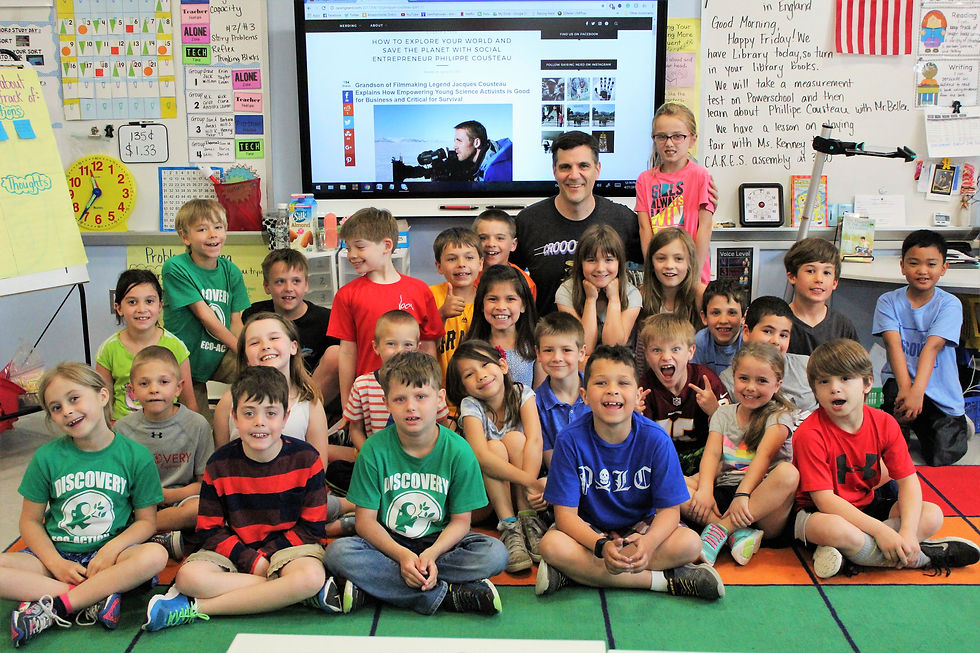
I was reminded just how much I missed all of it this week when the cover photo for this post popped up again on my social media feed.
In April 2017, my youngest daughter's 2nd grade and favorite teacher ever, Miss Ansell, saw an interview I conducted with environmental activist Philippe Cousteau for Raising Nerd. It was not by chance. My daughter, a great little publicist for her daddy, told her teacher about it! So, Miss Ansell asked if I'd like to come in to talk with her students on Earth Day.
While I'd been with those students many times before, this was the first time I'd specifically been asked to teach them something. But how could I resist? There is no higher honor than to be invited to talk with 25 seven-year-olds about how they can help save the planet.
Coolest Earth Day ever. As I wrote on our social media earlier this week, I hope that day has stuck with those kids as much as it did with me. Though I suspect probably not.

Regardless, in honor of Earth Day this week, the enthusiastic students still trying to save the world, and the importance of Dads in classrooms, I thought I'd include the bulk of that Raising Nerd interview with Philippe here on today's Daddying blog. It includes some excellent backstory about him growing up without his father, being raised by his mother, and the enduring influence of his pioneering grandfather. Some of the details and references may be dated, but the empowering messages are evergreen.
May we all take better care of the planet today and for all the kids and grandkids who will inherit it tomorrow. Thanks for reading and sharing the following interview post with them.
Daddy on!
A lengthier, two-part version of this post originally published on Raising Nerd, April 10 and April 17, 2017, to coincide with the blog's Earth Day celebration:
How to Explore Your World and Save the Planet with Social Entrepreneur Philippe Cousteau
Grandson of Filmmaking Legend Jacques Cousteau Explains How Empowering Young Science Activists is Good for Business and Critical for Survival
by Scott Beller
Imperfect Dad

“What is a scientist after all? It is a curious man looking through a keyhole, the keyhole of nature, trying to know what’s going on.”
Jacques Cousteau, Explorer, Conservationist & Filmmaker
Growing up before the Internet and 500 channels of digital HD cable existed, there were basically three ways most Nerds (or any kid like me) accessed and explored the mysteries of the natural world beyond their local ecosystem. If my friends and I wanted to see something more exotic than the occasional crayfish or turtle down at “the creek,” we either had to head to the library or catch The Undersea World of Jacques Cousteau and Marlin Perkins’ Wild Kingdom on Saturday mornings.
Jacques-Yves Cousteau’s documentary-style program nurtured a healthy respect for ocean habitats and concern for all creatures – both ordinary and extraordinary – dwelling within them. Undersea World also employed the filmmaker’s deliberate narrative style. As his distinctive, lilting French accent guided viewers through each episode’s adventure, Cousteau’s reverence for the environments and wildlife he and his crew explored was clear.
Now, four decades after the final TV voyage of Jacques Cousteau’s Calypso, his grandson Philippe carries on the family legacy of ocean conservation, filmmaking, and exploration. In fact, as an Emmy-nominated TV show host, environmental advocate, and self-described “social entrepreneur,” Philippe has helped take his family’s commitment to environmental education a step further.
In 2000, Philippe and his sister Alexandra established EarthEcho International, a nonprofit to honor their father Philippe-Pierre Cousteau, who had served as pilot, diver, photographer, director, and lead cinematographer for most of the Cousteau productions during his lifetime. Philippe, Sr.’s belief in “a world where every single child can breathe fresh air, drink clean water, and walk on green grass under a blue sky” continues to serve as EarthEcho’s vision today.
Catching Up With Cousteau
I met Philippe Cousteau, Jr., last fall at the Fast Company Innovation Festival in New York City. He had just finished participating in a panel discussion titled, “Oceans vs. Space: Which is Really the Final Frontier?”
Although he was in a time crunch to catch a plane, Philippe didn’t rush out the door. Instead, he lingered to talk and have his picture taken with an eager student, who had been waiting patiently for him. Watching his interaction with the young boy and the rapt attention he gave to every word, I immediately recognized their enthusiasm was mutual.
The personality and passion Philippe projects for the camera or when on-stage is no act. This guy is genuine. There were no cameras or crowds to impress while he spoke with this young fan. Yet he was thoroughly engaged and showed he really cared about what the student had to say.
Right then, I knew I had to invite Cousteau to do a Nerd Profile.
Because Philippe is such an energetic, charismatic, and high-profile personality with a healthy media platform from which to share his and EarthEcho’s environmental vision, his multifaceted career is helping to fulfill an often overlooked but vital role in the STEM/STEAM food chain: that of STEM communicator.
If you’ve ever seen one of his news segments on CNN or shows on Hulu, Fox, Great Big Story.com, and Discovery Channel, you know Cousteau, like his grandfather and father before him, gets his important messages across credibly, effectively, and with a just the right amount of artistic flair. He doesn’t just want kids to momentarily appreciate the beauty of far-flung places around the world. He also wants to mobilize, equip, and work hands-on with young citizen scientists, offering them the knowledge, technologies, and resources they need to actually help save the planet, one community at a time.
I waited my turn in the wings, hoping Cousteau might spare another minute for me before he had to leave. When he’d finished his visit with the boy, I quickly introduced myself and told him I thought Raising Nerd’s audience would benefit from hearing his story since our organizations shared some common goals:
Inspiring kids to be active
Engaging kids in a variety of creative STEM opportunities, and
Encouraging kids to explore, ask questions, and pursue their true passions.
Cousteau graciously accepted my interview request, asked for my business card, and said he or someone from EarthEcho would get back in touch. Four months later, I was finally able to wedge a Nerd Profile onto his crazy travel and production schedule. And now, as Earth Day 2017 (Saturday, April 22) approaches along with the March for Science, what better time to share his Nerd Profile with you and your Nerds?
We hope you enjoy Raising Nerd’s in-depth conversation with Philippe Cousteau:
Raising Nerd (RN): It’s clear the careers and expertise of your father and grandfather had an enormous influence on you given the focus of your work today. So, what was it like growing up in a family of explorers, environmentalists, and filmmakers – and essentially growing up in two countries, the US and France?
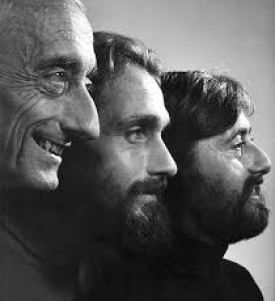
Philippe Cousteau (PC): Well, probably not what you’d expect. My father died six months before I was born. So, I was really raised by my sister and mother. Because of that, we didn’t spend a lot of time on expeditions. We saw my grandfather just a few times a year [when I was younger] but he certainly had some influence on me.
My childhood was a lot more “normal” than you might think. I was born in Los Angeles and lived there for many years. I was back and forth to France while growing up, but never lived there for longer than a year and a half. So, I mostly lived in California and Connecticut. I had the opportunity to spend time on some small trips. But by the time I was old enough to do it, my grandfather wasn’t really going on expeditions anymore. I kind of missed that by a few years.
But what mattered was the message and legacy of my father’s work and my grandfather’s work. Especially what I learned from my mother, who helped keep all that alive for me.
RN: What were some of your interests as a kid? How did family members encourage you in your pursuit of those interests?
PC: One of the things I was most fortunate to have from my father was his tremendous body of work. He filmed and produced most of those Undersea World of Jacques Cousteau episodes and, growing up, I got to watch all of those. I got to read the books he [and my grandfather] wrote. So, I had this body of work that a lot of people who lose their parents don’t have. Maybe, in that day, they might have a photo or an album or something. But I had this rich body of work that I could learn from and see what he was all about and learn about his legacy. My mother made sure that we saw those, we heard the stories, we watched the films, and read the books. We were fortunate in that respect. I think those were a lot of the early influences for [my sister and me].
RN: According to your bio, you have a master’s degree in history from St. Andrews University in Scotland. Since the ocean, exploring, and wildlife conservation are literally in your blood, when did you’d decide to follow in your grandfather’s and father Philippe’s footsteps instead – was there ever any doubt the path you’d take?
PC: No! When I was 16, I got an opportunity to go on an expedition – not with my grandfather but with a world-renowned oceanographer Dr. Eugenie Clark, a friend of ours.
It was the first time I got to go on a real expedition trip alone. It was to Papua New Guinea. We were doing a lot of research on the tides. Since it was in a very remote, rugged place like Papua New Guinea – an incredible spot – it was going to be eye-opening to the world. From that moment on, I realized that there was a way to hopefully make a living where I could explore the world, and film, and do scientific research.
I always saw my role to be the same as my father and grandfather’s. My grandfather was a naval officer. My father studied engineering and filmmaking in school. Even my uncle [Jean-Michel Cousteau] studied architecture. There wasn’t a scientist in the lot. And no one ever claimed to be a scientist. We’re storytellers. My grandfather was always very careful to be clear about that and also provide a platform for scientists to communicate their work.
I studied history specifically because I wanted to be able to understand how the world works, how people think and what motivates them. Knowing that I wanted to be a storyteller, I believed (and I still do) that history is a really important background to have and foundation for understanding people. If you want to inspire people and influence people to care about the world, then it’s important to understand their motivations and how they think, and why the world is the way it is.

RN: How does EarthEcho International continue your grandfather’s and father’s mission of helping promote ocean, wildlife, and water conservation?
PC: A wise man once told me if you don’t have a youth strategy, then you don’t have a strategy at all. Having grown up with people like my grandfather, my mother, family friends, expedition leaders, and the people who worked with my father, I often thought about my life and what influenced me. And when I was coming out of college I realized I wasn’t [interested in the ocean and environmental issues] simply because of the name on my birth certificate. I was engaged [in these issues] because of good teaching from a young age.
When we were looking to create an organization, I looked around at a lot of the big NGOs (non-governmental organizations) and saw, pretty much across the board, there was lack of a real youth strategy. There were other great organizations already doing great research. So, I thought about where we could meaningfully contribute without reinventing the wheel. We felt that a youth strategy was important and a place where we could make an impact.
That’s what inspired EarthEcho.
That and all those days sitting on my grandfather’s lap from a young age, just talking and hearing the stories about what he did. Then as I got older, going out to dinner with him, drinking wine, and enjoying those kinds of things – always in the context of his experiences – those were good teaching moments. Story is the language of learning. So, EarthEcho asks how we can be storytellers to a whole new generation and inspire them the way my grandfather inspired me.
RN: How does EarthEcho empower young people to create changes in their community? Does the organization only work with kids through school programs or are there other opportunities for kids to get involved?
PC: We work with young people both inside and outside the classroom. We believe in the power of young people. We believe they can make a positive difference in their communities – that they can take action and be agents for change. That’s really our focus.
We don’t look at just raising awareness or providing young people with “educational products.” We provide context and information about the world around them – a world they are curious about. Then we seek to engage them in ways that enable them to do something to affect change. Our programs vary from broad initiatives to classroom curriculum.
One global program, the EarthEcho Water Challenge is about water quality. It’s a “citizen science” program and the largest of its kind in the world, allowing young people to get engaged through after-school groups, faith-based organizations – you name it – in testing water quality around the world. More than 60 countries have participated in the project over the past few years.
We also provide a lot of curriculum content in classrooms to help teachers – who are so often undervalued in this country – do their jobs and give them the resources and tools to make what they’re already teaching in their classrooms come alive.
And we’re creating a new program STEMExplore with United Technologies all about profiling STEM careers. It leverages a lot of the media work I do, including the content we gather and documentary filmmaking we do on expeditions, and brings that into the classroom. It addresses a huge issue in this country with respect to workforce readiness.
We’re really looking to inspire, engage, motivate, and give young people the tools to take action.
RN: You’ve co-written some great books for kids, including Going Blue: A Teen Guide to Saving Our Oceans, Lakes, Rivers & Wetlands, Make A Splash!, and Follow the Moon Home. How do these books encourage kids to get involved in conservation efforts?
PC: All those books have the consistent theme of kids changing the world.
Make A Splash and Going Blue are both practical guides that are specifically focused on and provide activities to solve environmental problems. Make A Splash is for elementary school kids and Going Blue is for middle and high school. Those books were designed as guides to help kids understand how to take action.
Follow the Moon Home is a picture book and fictional narrative. It’s about a little girl who moves to a new town and, as her summer project, she decides to gather her friends and take the initiative to protect sea turtles.
The whole idea [behind the book] is still “Young people can change the world. They don’t have to wait for adults.” In fact, kids often are the ones that drive the initiative, and we wanted to profile that kind of behavior. We looked at Make A Splash and said OK, what’s the “ideal child” [who would use this guide] and what would they do? That’s where the story of Vivian in Follow the Moon Home comes from. In my mind, the story is a good example of how young people can change the world by motivating their entire community and helping change attitudes, hearts, and minds.

RN: Most people know you as an explorer, environmental advocate, and TV host but you also refer to yourself as a “social entrepreneur.” Can you tell us more about that less familiar “title,” and why it has become an important aspect of your work?
PC: To solve problems in the world today, we need more than just non-profits, NGOs, and foundations. There’s no question those organizations are important, but they’re insufficient on their own. We need businesses and industry to be a part of the solutions.
About six or seven years ago, I recognized the need and an opportunity for me to be involved in the “impact investors” movement. Basically, finding ways for people to put their money where their mouth is in terms of investing in businesses that are not only profitable, but also share the same kind of environmental, social, and governance values that a lot of people care about.
So, we launched an investment fund on the New York Stock Exchange about five years ago called the Global Echo Exchange Traded Fund to give people an easy way to do this. The idea was to create an impact investment platform that would give back a percentage of the financial advisors’ management fee to our charitable foundation, the Global Echo Foundation. The Foundation then invests in initiatives around women and girls and environmental sustainability, which are all connected.
As social entrepreneurs, we’re attempting to leverage business, industry, and nonprofits to solve problems.
With initial funds from the Foundation, our project built solar panels at Panzi Hospital in the eastern part of Democratic Republic of Congo, which is world-renowned for its treatment of survivors of sexual violence as well as its healthcare for women, girls, and children, in general. And this is in a part of the world that so desperately needs help and is so ridden by strife – much of it driven by [scarcity of] natural resources in Congo.
As my grandfather always said, “You can’t build environmental sustainability without building human sustainability.” And the best way to do that is to invest in women and girls. This project invested in supporting Panzi Hospital as a way to help them transition off fossil fuel, reduce the destruction of natural resources in that country, and empower women and children in that community to help build a more sustainable society.
We look at the intersection between people and the environment, which is where we need to be looking. If we can solve human problems we can solve environmental problems at the same time, and vice-versa.
RN: What advice do you have for the future scientists and explorers out there that dream of building a career like yours? What activities, education, clubs memberships, or other activities should they pursue?
PC: In addition to learning how to problem solve and think critically – maybe the most important skills of all and ones we all need to continue developing –my number one piece of advice is to learn how to communicate and how to be a storyteller.
Even though I’m not a scientist, in many ways, my career certainly intersects with STEM as a communicator. So, I always tell young people that no matter what you are interested in doing in your life, study communication. Make that part of your education.
Because if you’re a scientist, guess what? That skill is going to be useful for you to help get grants for your research. The ability to communicate your message and what you care about will help sell people on why what you’re doing is important. Whether you’re an engineer or a doctor, communication is going to be important. Telling stories, being comfortable talking to people, and even understanding the basics of broadcasting and online media are all important for anybody [to succeed] in the world today.
There are surveys that ask people about what scares them the most, and public speaking is consistently ranked higher than death…which is ridiculous, obviously. I tell young people the best thing they can do, no matter what they’re interested in, is learn how to speak, articulate ideas, and present yourself. That stuff matters.
Getting up in front of an audience, selling an idea, and communicating the importance of and a passion for an idea you care about is hard. It takes constant effort and constant practice. So, I tell high school kids to go back to their middle or elementary schools. Just do it. Give a presentation about a school project you did or trip you went on. Sure, it’s going to scare the crap out of you – because it certainly did me – but the only way to get good at it is to do it.
RN: Who are your professional mentors or inspirations today? Who inspires you and motivates you to do what you do?
PC: I think most people are inspired by people who advocate for important movement in the world and do great things. Dr. Denis Mukwege, who founded the Panzi Hospital, is someone who inspires me. Malala inspires me. For me, it’s really anybody that looks at adversity and says I’m not going to accept this as the status quo. I’m going to do something different.
My mom also inspires me still. Given what she went through, how she raised two kids by herself, and kept my father’s legacy alive in the face of incredible difficulty and adversity…it’s pretty inspiring.
RN: You’ve said you hope to have kids some day. How would you try to inspire your own child to pursue his or her own creative passion in whatever field they might choose?
PC: I’m a big believer in doing. My mom was also a big believer in that. She was always the kind of person who would come take us out of school so we could go on a trip. Whenever opportunities came up to do these kinds of things or go somewhere local – maybe a factory to learn how things work – my mom was always a big advocate for us doing that. So she’d often have to argue with school administrators about something like me missing a math test. She’d tell them that I probably wasn’t going to learn nearly as much from taking that test as I would taking a trip to Papua New Guinea or going to see the sights at a national park. I mean, you don’t have to go halfway around the world to find amazing experiences!
My mom wanted us to have real-world experiences. I think that’s the best way to make things come alive for young people. It’s not about sitting in front of a TV, which I think often substitutes for parenting these days. It’s about getting outdoors and seeing how the world works. There are so many lessons to be learned in nature that can pretty much relate to anything.
At EarthEcho, one of the reasons we do a lot of curriculum enhancement work around the environment is because that’s how you learn how the world works. It all comes from the environment. Biology and chemistry are how the world works – how nature works. When it comes to STEM, I advise kids to just go outside, see how things work, and ask more questions!
RN: [I pointed out it must pain him to tell kids not to watch TV since, you know, he hosts several TV shows…]
PC: [laughing] Well hopefully all we’re doing when we’re on TV is inspiring people to want to go explore and see things for themselves or, at least, let them see things they wouldn’t have had been able to see otherwise – and spark their interest in nature. That’s really why we do what we do.
But, yeah, I would much rather kids go outside and play in the woods than sit at home and watch Xploration Awesome Planet. But I hope that when they are at home they will watch Awesome Planet, because it’s about the woods and how the world works, and volcanoes and scuba diving and sharks and all this great stuff. But given a choice, yeah, go outside and don’t watch a TV show, not even mine.
RN: What does an explorer/environmental activist/globetrotting TV star do to relax?
PC: Staycation! I like to hang out at home with the Mrs. and the dog (we have a Siberian husky that we rescued about a year ago). On a Sunday morning, wake up, make some pancakes and just not go anywhere or see anyone. Yeah, my vacation is a staycation.
Raising Nerd’s final question for Philippe came from my curious 9-year-old and Raising Nerd special correspondent, RocketteGirl, who was dying to “meet” him.
RocketteGirl: What’s your favorite place to explore in the whole world?
PC: [Chuckles, thinks for a moment] Wherever I am.
It could be in the backyard, just looking at the flowers and trees and bushes, or digging through the soil. Or…Nepal or Australia or…just whatever place it is that I get to go.
I’m always inspired by the story from a few years ago about the scientist from the Smithsonian Institution, who discovered a new species of insect in his own backyard in the Washington, D.C., area. So, yeah, I think my favorite space to explore is whatever is all around me.
Daddying Film Festival & Forum 2027
June 21, 2026

Save the Dates: The 6th annual, virtual Daddying Film Festival will take place on Eventive, January 11-20, 2027, and our LIVE Daddying Film Forum will screen Atticus Award winners and finalists, January 29-30, 2027! Start planning your submissions now for the D3F 2027 Call for Entries, which opens this Fathers' Day, June 21st. More D3F news to come!

Scott Beller is the proud, imperfect crew Dad of two teen, mighty girls, imperfect partner of their rock-star mom/regatta chaperone, a truth teller, purveyor of banned books, former youth soccer coach, championship basketball coach, retired part-time driving instructor, late-night filmgoer, Editor of the Daddying blog, Director of Communications for DCG and Associate Director of the Daddying Film Festival & Forum (D3F). He's a seasoned writer and PR agency veteran with more than 35 years of experience helping organizations of all sizes and individuals reach audiences and tell their stories. Prior to launching his own creative communications consultancy in 2003, he led PR teams with some of the world’s most respected agencies, including The Weber Group and Fleishman-Hillard. As a consultant, he’s helped launch two other parenting advocacy nonprofits with DCG founder Allan Shedlin, REEL Fathers and Dads Unlimited. His first book, Beggars or Angels, was a ghostwritten memoir for the nonprofit Devotion to Children's founder Rosemary Tran Lauer. He is formerly known as "Imperfect Dad" and Head Writer/Editor for the Raising Nerd blog, which supports parents in inspiring the next generation of scientists, engineers, and creative problem solvers. He earned his BA in Communications from VA Tech so many years ago. You can follow him and his frequently salty language on Instagram and BlueSky.


Comments